ABB Robots and PSYONIC Advance Bionic Dexterous Hand Technology to Improve Robot Grasping Capabiliti
Time:2026-07-14 Browse: 22
ABB Robotics and PSYONIC are collaborating to enhance robot dexterity by integrating bionic hand technology, tactile sensing, and human operation data to improve autonomous multifunctional robots (AVR™) for industrial applications.
ABB Robotics has announced a collaboration with US-based bionic technology company PSYONIC to explore new approaches for improving robotic grasping and dexterous manipulation capabilities. The cooperation focuses on integrating PSYONIC’s Ability Hand bionic dexterous hand with ABB GoFa™ collaborative robots to investigate how human prosthetic operation data can be used to train robots for more advanced and adaptive industrial tasks.
Robot dexterity remains one of the biggest challenges in industrial automation. While traditional robotic systems can perform repetitive operations with high precision, they often struggle with complex tasks involving irregular shapes, fragile components, and constantly changing working conditions. By combining tactile sensing technology, flexible mechanical structures, and real-world human operation data, ABB and PSYONIC aim to close the performance gap between human hand skills and robotic manipulation.
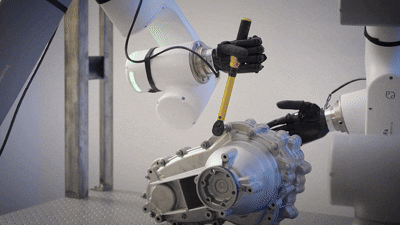
Human Operation Data Enables More Advanced Robotic Manipulation
PSYONIC Ability Hand was originally developed for advanced prosthetic applications. The bionic hand combines electromyography (EMG) control, tactile sensors, vibration feedback, and lightweight multi-joint mechanical structures to replicate natural hand movements.
The integrated pressure sensors and feedback systems allow users to perceive contact conditions, grip force, and object interaction. Its flexible fingers are designed to adapt to different object shapes, including irregular and variable surfaces.
Through the collaboration with ABB Robotics, the same Ability Hand technology used in prosthetic applications is being evaluated for robotic systems. Data collected from human hand movements, contact forces, and gripping actions can provide valuable information for training robots to perform more intelligent and adaptive operations.
This approach supports the development of next-generation physical AI systems, where robots can learn from real-world interactions and improve their ability to handle complex industrial environments.
ABB GoFa™ Collaborative Robot Supports High-Precision Testing
ABB GoFa™ collaborative robots provide the accuracy, repeatability, and reliability required for testing advanced robotic manipulation technologies. During the evaluation process, GoFa robots are used to accurately execute and analyze gripping force, finger positioning, and movement changes.
The combination of ABB’s robotic platform and PSYONIC’s tactile-enabled bionic hand allows engineers to study how human-like sensing capabilities can be transferred into industrial automation applications.
The technology has potential applications across multiple industries, including automotive manufacturing, aerospace production, packaging and logistics, and life sciences. By enabling robots to handle delicate, complex, or ergonomically challenging tasks, the collaboration could improve production flexibility, operational safety, and human-machine collaboration.
Supporting the Development of Autonomous Multifunctional Robots
ABB Robotics identifies grasping and dexterous manipulation as key technologies for autonomous multifunctional robots (AVR™). The concept focuses on developing robots capable of sensing environments, making decisions, moving autonomously, and performing precise material handling operations in dynamic production conditions.
Advanced manipulation capabilities are considered essential for industrial physical AI development. Robots equipped with better sensing and learning abilities can adapt more effectively to real-world manufacturing challenges while maintaining industrial reliability.
ABB and PSYONIC will continue evaluating the integration of bionic hand technology with robotic systems, exploring new automation solutions for applications where traditional grippers have limitations.
Improving Automation Efficiency Through Advanced End-of-Arm Technology
The development of intelligent gripping systems is becoming increasingly important as manufacturers demand more flexible automation solutions. Advanced end-of-arm technologies can reduce engineering adjustment requirements, accelerate deployment, and improve the return on automation investments.
According to industry research, optimized gripping technologies combined with digital automation solutions can significantly reduce commissioning time in complex applications. This highlights the growing importance of intelligent robotic hands and adaptive grippers in future manufacturing environments.
Through cooperation with technology partners such as PSYONIC, ABB Robotics continues expanding its robotics ecosystem by combining industrial robots, artificial intelligence, and human-derived operational data. The goal is to create more capable robots that can operate reliably in diverse and challenging production scenarios.
As robotics technology continues to evolve, bionic sensing and AI-driven learning capabilities may become key factors in enabling the next generation of flexible industrial automation.