Allen-Bradley MPL-A330P-HJ74AA Servo Motor Installation Guide
Time:2026-08-28 Browse: 11
The Allen-Bradley MPL-A330P-HJ74AA servo motor is a 230 V-class MP-Series low-inertia brushless servo motor with a 100 mm frame, 76.2 mm magnet stack, 5,000 rpm rated speed, 2000-line incremental encoder, keyed shaft, and 24 V DC holding brake. For reliable installation, the motor should be treated as part of the complete servo system rather than as an isolated motor component.
MPL-A330P-HJ74AA Servo Motor Installation Preparation
Before mounting the motor, verify the complete catalog number against the machine's existing motion configuration. This is particularly important when replacing an MP-Series motor because visually similar MPL-A330P models can use different feedback technologies, shaft configurations, or brake options.
The HJ74AA uses a right-angle SpeedTEC DIN connector, a keyed shaft extension, and a 24 V DC brake. Its 100 mm frame and 76.2 mm magnet stack should also be checked against the available mechanical space.
A practical installation inspection should cover:
Motor catalog number and nameplate
Servo drive compatibility
Motor power cable
Feedback cable
24 V DC brake circuit
Protective grounding
Shaft coupling and alignment
Available mounting clearance
Motion controller System Configuration
Do not begin commissioning until the motor identification and drive configuration agree.
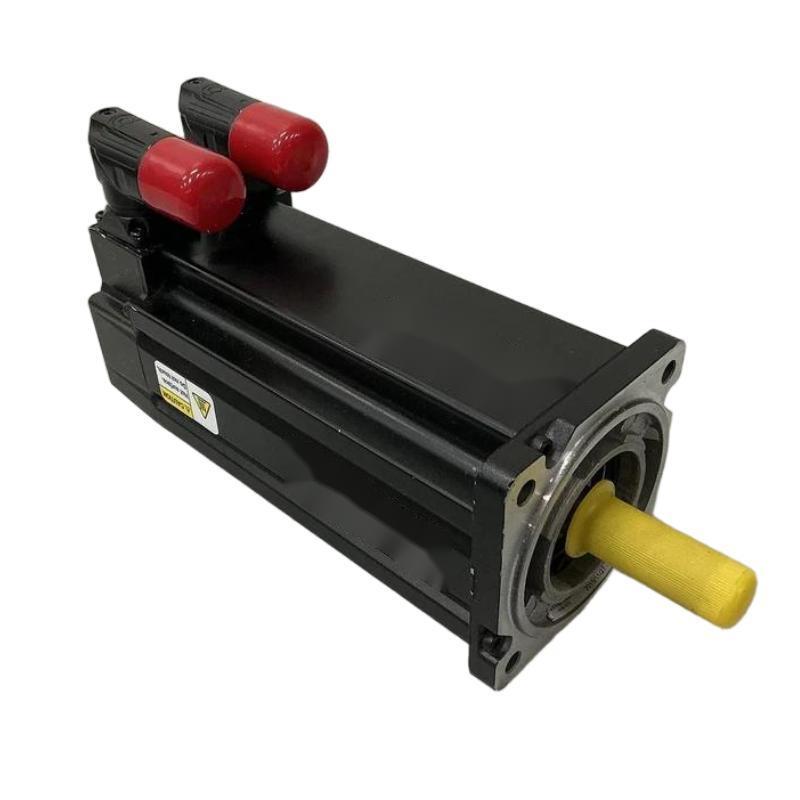
Allen-Bradley MPL-A330P-HJ74AA Mechanical Setup
Mechanical alignment should be completed before servo tuning.
The keyed shaft is intended for applications where positive mechanical torque transmission is required. The coupling should be installed without forcing the shaft into an offset position. Excessive radial or axial loading can produce vibration that may initially look like a servo tuning problem.
Where the machine permits it, an effective commissioning method is to test the motor with the mechanical load uncoupled. This provides a useful baseline for distinguishing motor/drive behavior from load-related problems.
Check the following before energizing:
Flange mounting surface is clean and flat
Motor mounting bolts are correctly secured
Coupling is aligned
Shaft key is properly seated
No mechanical interference exists
Brake release is understood
Motor cables cannot pull against the connector
The HJ74AA includes a 24 V DC holding brake, so the brake circuit must be considered as part of the mechanical installation rather than treated as an optional accessory.
MPL-A330P-HJ74AA Servo Motor Wiring and Feedback
The electrical installation should keep motor power, feedback, and brake wiring clearly identified.
The HJ74AA uses a 2000-line incremental encoder. The encoder feedback is therefore essential to the servo drive's position and velocity control.
During wiring, verify:
Motor power connections match the applicable drive documentation
Protective earth is properly connected
Feedback connector is fully seated
Feedback cable shielding is correctly terminated
Brake wiring is connected to the correct 24 V DC circuit
Power and feedback cables are routed to minimize electrical interference
Cable movement does not place stress on the motor connector
A common field mistake is to reuse the cable and configuration from a visually similar motor without checking the actual feedback specification. The HJ74AA should be configured according to its own catalog number.
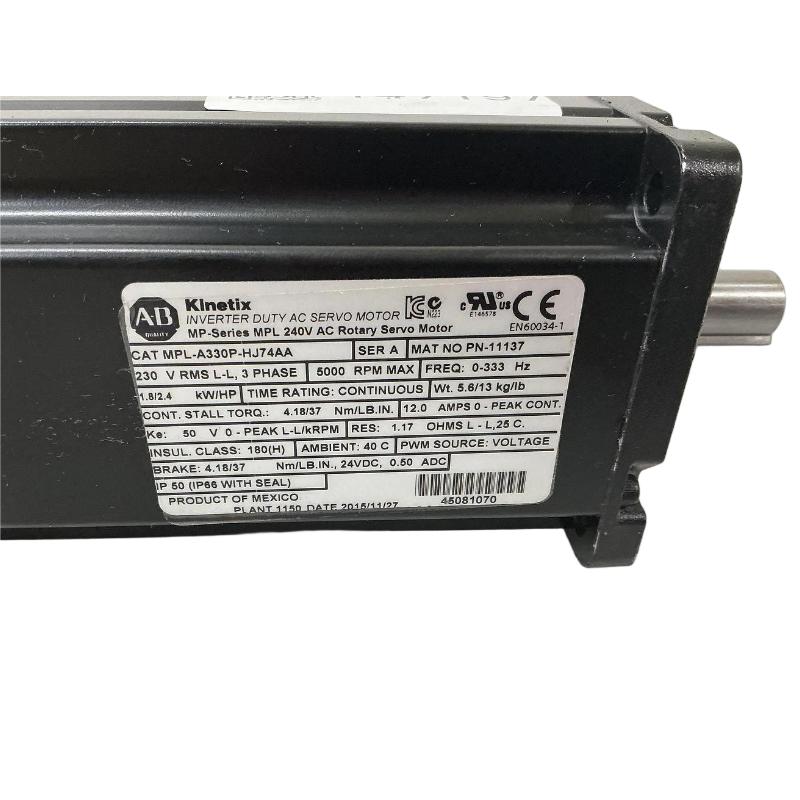
MPL-A330P-HJ74AA Commissioning Checks
Initial Setup / Commissioning should be performed at controlled speed and with the machine in a safe operating condition.
A useful commissioning sequence is:
Power verification → feedback verification → brake check → servo enable → low-speed jog → position verification → load test
During the first movement, monitor:
Actual position
Commanded position
Actual velocity
Following error
Drive current
Feedback status
Motor noise
Mechanical vibration
Brake behavior
Do not begin with a high-speed motion command. A low-speed jog gives the technician much more useful information if the feedback direction, brake timing, or mechanical alignment is incorrect.
Real Field Case: MPL-A330P-HJ74AA Commissioning
In one MP-Series commissioning case, a replacement motor produced a feedback-related fault immediately after the axis was enabled. The initial assumption was that the replacement motor had a defective encoder.
The diagnostic process started with the motor catalog number rather than the motor hardware. The actual motor used a 2000-line incremental encoder, while the existing axis configuration had been copied from another servo motor with different feedback characteristics.
After correcting the System Configuration and verifying the feedback circuit, the axis enabled normally.
The engineering lesson was straightforward: when a servo motor faults immediately after replacement, verify the motor identity and feedback configuration before replacing the motor again.
MPL-A330P-HJ74AA Installation Troubleshooting
If the motor does not operate correctly after commissioning, use the fault behavior to narrow the problem.
Fault immediately at servo enable: check feedback configuration, connector seating, encoder circuit, and brake status.
Motor runs but position is incorrect: check feedback scaling, motor configuration, and mechanical coupling.
Motor vibrates at low speed: check mechanical alignment before changing tuning parameters.
Motor faults during acceleration: inspect feedback cable routing, connector strain, electrical interference, and load conditions.
Brake does not release: verify the 24 V DC brake circuit and the drive's brake-control sequence.
This approach prevents unnecessary motor replacement and keeps the Fault Diagnosis process focused on measurable evidence.
MPL-A330P-HJ74AA Installation Long-Tail Keywords
Allen-Bradley MPL-A330P-HJ74AA installation
MPL-A330P-HJ74AA servo motor wiring
MPL-A330P-HJ74AA Installation Guide
MPL-A330P-HJ74AA commissioning
MPL-A330P-HJ74AA encoder setup
MPL-A330P-HJ74AA brake wiring
MPL-A330P-HJ74AA servo drive configuration
MPL-A330P-HJ74AA System Configuration
Allen-Bradley MP-Series servo motor setup
MPL-A330P-HJ74AA servo motor commissioning
MPL-A330P-HJ74AA Product Status
Rockwell Automation lists the MPL-A330P-HJ74AA as discontinued, with a discontinuation date of July 23, 2024. Rockwell identifies MPL-A330P-SJ74AA as an engineering replacement. The replacement uses a single-turn high-resolution encoder, so it should not be treated as a direct feedback-equivalent substitution without checking the complete motion-system configuration.